Visiting the Nahe wine region’s iconic Weingut Dönnhoff
Weingut Dönnhoff Riesling is known to be one of the best Nahe wines and best German Riesling wines - a good enough reason to visit!
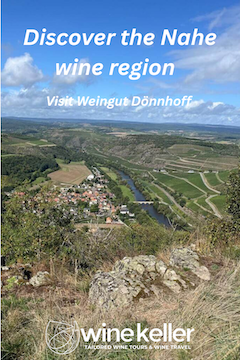
The Grand Cru vineyards of the Middle Nahe wine region - Source: Winekeller
Nahe Riesling wine is known throughout the world for its elegance, finesse and purity and Weingut Dönnhoff in the Middle Nahe wine region is an icon of Nahe Riesling. Helmut Dönnhoff from the Hermann Dönnhoff estate was the trailblazer for top quality Nahe Riesling in the early 1980s and Weingut Dönnhoff is still its top wine producer today.
Known for its top quality, single vineyard, Grand Cru Riesling wines, we were eager to discover the Nahe wine region and to check out this iconic German wine producer!
About Weingut Dönnhoff Nahe
Weingut Dönnhoff, a family-owned, VDP classified winery dating back some 250 years and located in the village of Oberhausen an der Nahe in the middle part of the Nahe region, is widely regarded as one of the benchmark producers not only of the Nahe wine region, but of all German Riesling.
The estate’s reputation was built largely by Helmut Dönnhoff, the grandson of the founder, Hermann Dönnhoff, who took over the family winery in the 1970s and helped transform the Nahe wine region from a relatively overlooked region into one internationally associated with world-class Riesling. During the 1980s and 1990s, Dönnhoff wines - predominantly Dönnhoff Rieslings - became reference points for purity, precision, and site expression.
Today the winery is run by Helmut’s son, Cornelius Dönnhoff, who has continued the house style while refining vineyard work and precision in the cellar. The estate is certified sustainable and produces some 180,000 bottles per year. Key international markets include the US (Dönnhoff was the first producer in the Nahe wine region to export to the US in significant quantities), Norway and Sweden.
Note - Weingut Dönnhoff is a member of the VDP - Germany’s ‘VDP’ classification for its top vineyard sites. The VDP is a private association of some 200 top German wine producers whose aim is to highlight the value and origin of the best vineyard sites in Germany, to strengthen the profile of Germany’s best dry wines and to emphasise the importance of the Premium Quality Wines.
Here is a quote from Cornelius Dönnhoff, which summarises why the Nahe’s Weingut Dönnhoff is so special:
“We have been at home here in Oberhausen an der Nahe for more than 250 years, in the scenic valley between Niederhausen and Schloßböckelheim. We are known worldwide for our elegant Rieslings, which reflect the geological diversity of our region's soils in an exciting way. We are very lucky to cultivate our Rieslings in some of the most famous locations of the Nahe. We take up this challenge with joy, in responsibility for nature and our homeland. With Niederhausen and Oberhausen, Schloßböckelheim, Norheim as well as Roxheim and Bad Kreuznach, our property diversifies widely and covers dozens of rock types and soil characteristics which are reflected in our wines. With us you have the whole white variety of the Nahe in one enterprise!”
The stone bridge separating the famous Nahe Grand Cru vineyards: Source - Winekeller
The world-famous Nahe Grand Cru vineyards
The premium Nahe Riesling vineyard sites and wine villages are located along the stretch of the River Nahe from Monzingen to Bad Münster am Stein. At the heart of this beautiful section of the river lie the two celebrated wine villages of Niederhausen and Oberhausen, located on either side of the Nahe, linked by a beautiful stone bridge.
These two Nahe villages are known for their famous ‘Grand Cru’ vineyard sites, most of which lie on the Niederhausen side of the river, in former Prussia. Weingut Dönnhoff is located on the Bavaria side of the Nahe, in Oberhausen, which has two Grand Cru sites, ‘Leistenberg’ and Brücke (a monopole site solely owned by Weingut Dönnhoff).
Amongst the Grand Cru sites on the former Prussian side of the River Nahe, is Hermannshöhle (Hermann’s Cave), often considered one of the greatest Riesling vineyards in the world.
Note - ‘Grand Cru’ wines in Germany are known as VDP. Grosse Lage wines, made from grapes from the highest quality German vineyards. The locations are split into parcels that produce the best wines expressing terroir and with special ageing potential. (The dry wines are called VDP. Grosses Gewächs wines - commonly called GG)
The Nahe village of Oberhausen and the famous vineyards opposite: Source - Winekeller
Oberhausen from the opposite side of the river, Niederhausen: Source Winekeller
Dönnhoff vineyards
Today the Dönnhoff family farms approximately 30 hectares of vineyards, across a total of 10, mostly legendary, Grand Cru vineyard sites, planted with 80% Riesling and 20% Pinot Blanc, Pinot Gris and Chardonnay.
With plantings spread across these different vineyard sites, Weingut Dönnhoff is able to produce a wide variety of wines. Wines produced from grapes grown on the slate and volcanic soil sites in the valley around Oberhausen and Niederhausen are typically pure, elegant and mineral, which are quite different from those produced from grapes away from the valley slopes, closer to Bad Kreuznach. Here the terroir is very different, with the soils containing more loam and quartz and there is also a greater influence here from the River Rhine.
In addition to the three Grand Cru vineyard sites already mentioned, ‘Leistenberg’, Brücke and ‘Hermannshöhle’, Weingut Dönnhoff farms plots on the following top sites: ‘Felsenberg’, ‘Klamm’, ‘Dellchen’, ‘Kirschheck’, ‘Kahlenberg’, ‘Krötenpfuhl’ and ‘Höllenpfad’.
Dönnhoff Riesling
The main reason Weingut Dönnhoff became such an important estate in the history of German wine was the approach of Hermann Dönnhoff back in the 1920s, who recognised that the future of fine German wine lay in exceptional vineyard sites and in the expressive potential of Riesling.
Demonstrating incredible forward-thinking for that time, rather than selling wine in bulk and blending wines across multiple vineyard sites, he focused on acquiring and cultivating top parcels in the Middle Nahe and bottling wines under their individual vineyard names. This early ‘single vineyard’ practice aligned Dönnhoff with the great vineyards and wines of Burgundy and helped establish the prestige of these now legendary vineyard sites, as well as Dönnhoff Riesling wines.
What makes Dönnhoff Rieslings especially admired today is the combination of intense minerality, crystal-clear fruit purity, low alcohol, significant ageing potential and the individual vineyard and terroir expression.
Our wine tasting at Weingut Dönnhoff
When we visited Weingut Dönnhof we travelled by car from Frankfurt, which was an easy journey lasting just over an hour. The winery is located right in the centre of the village of Oberhausen and is easy to find.
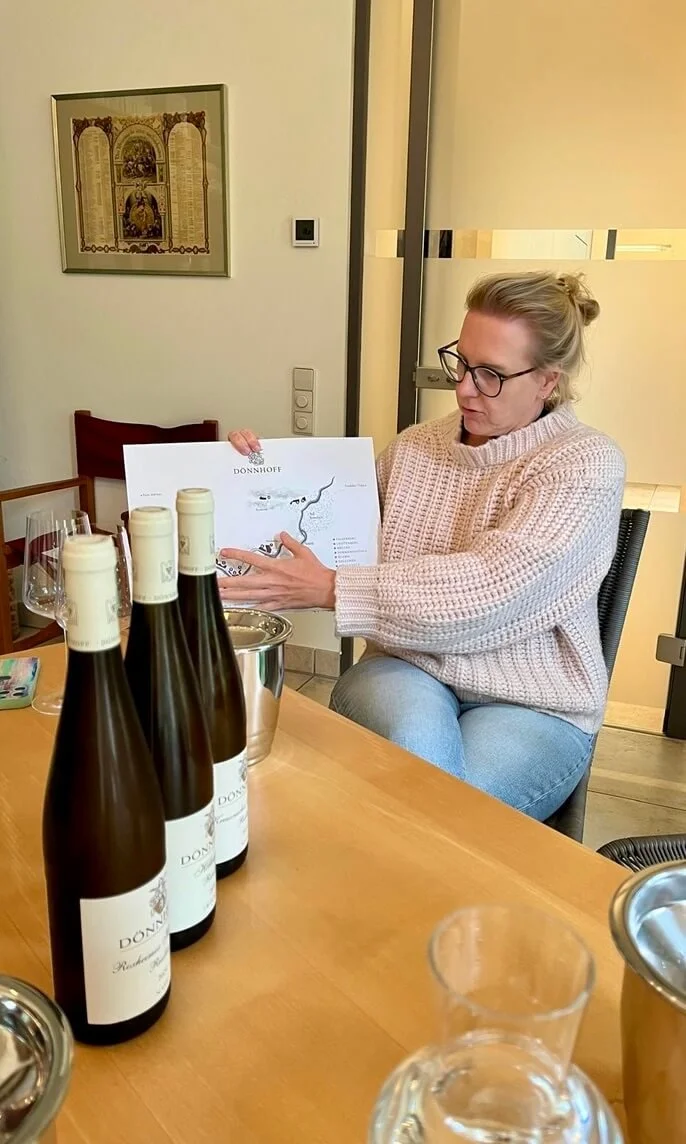
We joined a couple of other people for a really superb wine tasting with Anna Dönnhoff, who gave us an excellent insight into the family estate and its history, followed by an overview of the vineyards and the wines.
Our Weingut Dönnhoff wine tasting, with Anna Dönnhoff - Source: Winekeller
We then went on to enjoy an excellent wine tasting, which incorporated a broad range of wines from the different vineyard sites.
We started with some dry Rieslings - and first up was an ‘estate wine’ - Gutswein Riesling Tonschiefer ‘24.
This was described by Anna as the ‘liquid business card for Dönnhof’, the wine that most typically represents the estate. An entry-level Riesling, beautifully sharp and mineral, made from grapes grown mostly on the Leistenberg vineyard, with dark clay slate soils.
This was followed by a ‘VDP.Ortswein’ wine - a wine which comes from the best vineyards within the town/village, planted with typical grape varieties. The Schlossböckelheimer Riesling ‘24 is made from grapes grown on a site in the Felsenberg Grand Cru vineyard, with its flinty, hard, volcanic soils.
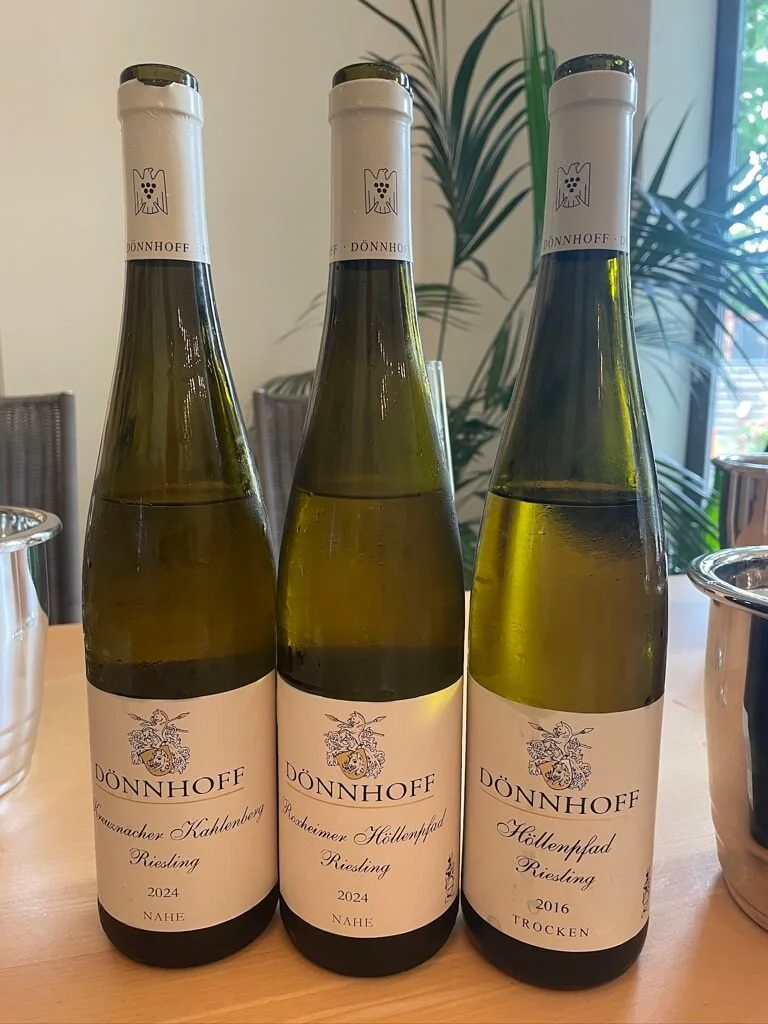
Anna then took us on a journey away from the valley and to the Kahlenberg vineyard where the soils are warmer, with more gravel/loam. The Kreuznacher Kahlenberg ‘24 Erstes Gewächs is a ‘Premier Cru’ wine with wonderful spicy, mineral, fruity notes - quite different to the Rieslings produced from the slate soils of the valley vineyards.
Next, another ‘Premier Cru’ wine, the 2024 Roxheimer Höllenpfad Erstes Gewächs - made from grapes grown on a famous vineyard slope in a remote side valley of the Middle Nahe region. Höllenpfad (Hell's Path) refers to the steepness of the slope as well as its striking red colour. These unique red sandstone soils give this wine its wonderful spicy flavours with floral layers. Anna also invited us to sample the 2016 vintage of this superb wine, which proved beyond any doubt the incredible ageing potential of the Dönnhohf Rieslings.
Staying in the Höllenpfad vineyard, we moved on to the 2024 Höllenpfad in Mühlenberg - Grosses Gewächs (GG) - a Grand Cru wine made from grapes from a very special vineyard plot at the centre of the Höllenpfad vineyard, where the oldest vines are planted and which produces consistently outstanding quality wines. At just over 1 hectare, this is a monopole site belonging to Weingut Dönnhoff.
The world-famous Hermannshöhle vineyard, Niederhausen - Source: Winekeller
Last but certainly not least of the dry Rieslings for us to sample, the top-rated GG wine, the 2024 Hermannshöhle, Grosses Gewächs, a powerful yet elegant dry Riesling, made from grapes grown on vines up to 75 years old. The soils on this legendary Hermannshöhle vineyard are exceptionally rich in minerals and have been producing incredible Rieslings for over 100 years. This wine is a superb example of why the Hermannshöhle vineyard is considered the highest-rated in the entire Nahe region and ranks among the best Riesling sites in the world. (We also had the chance to taste the 2014 vintage).
Next we were introduced to Dönnhoff’s fruitier Riesling wines…
We started with the 2024 Riesling semi-dry entry-level fruity wine, another classic Dönnhoff and Nahe Riesling wine. With 20g of residual sugar and just 10% alcohol, this is a wonderful wine for pairing with Asian food or just enjoying on its own - we LOVE this wine!
We then went on to the 2024 Oberhäuser Leistenberg Riesling Kabinett - a lovely, delicate, fruity Riesling with just 9% alcohol and made from grapes form the estate’s oldest vineyard.
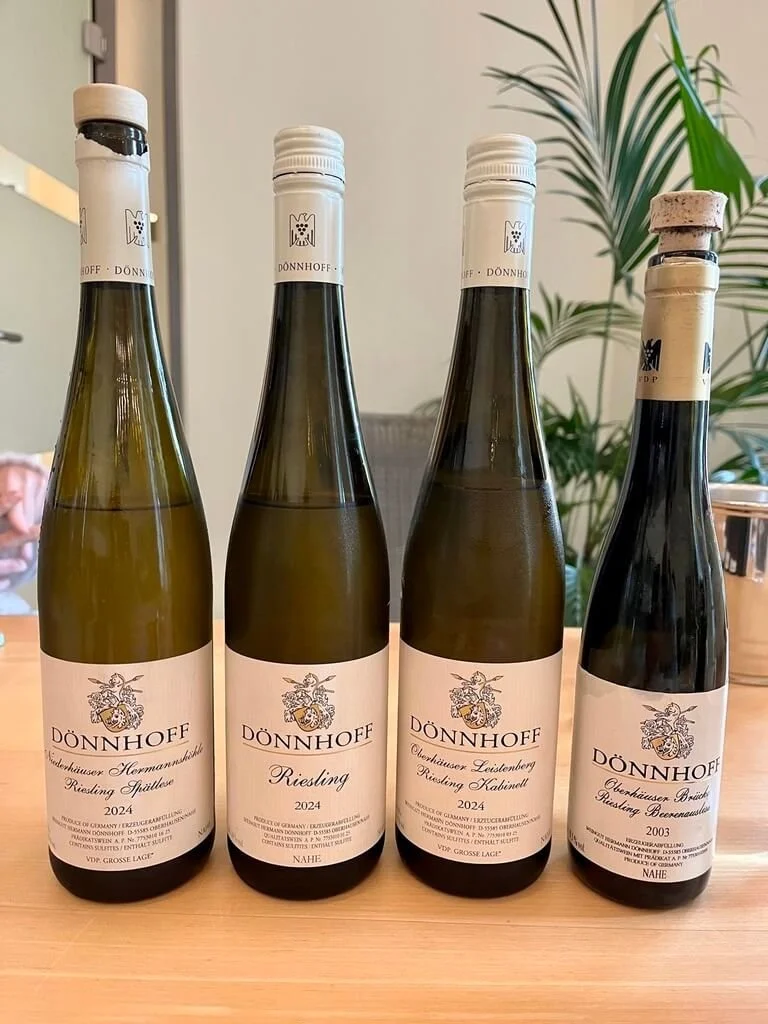
Next we tasted the 2024 Niederhäuser Hermannshöhle Riesling Spätlese - a noble and classic late harvest wine, incredibly rich in fruit aromas with 65g of residual sugar, made from grape from this top Riesling vineyard.
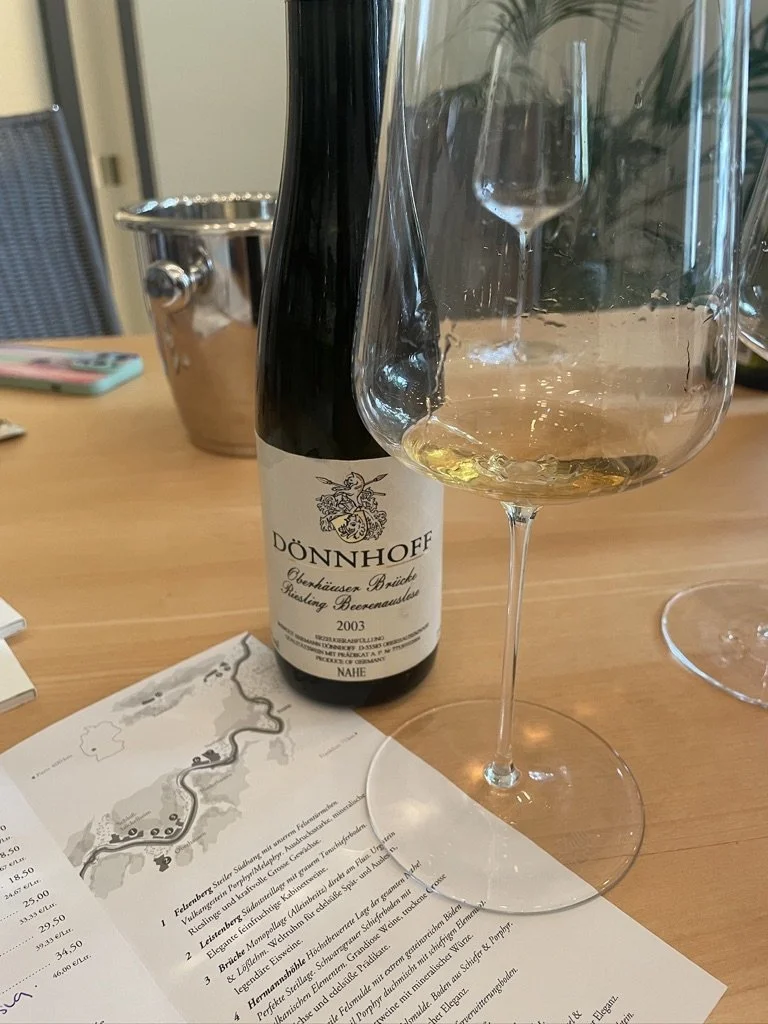
Finally, as a special treat, Anna offered us a taste of an incredible cellar wine - a 2003 Beerenauslese wine made from grapes from the Brücke vineyard - the smallest vineyard in the valley, known for producing late-harvest, complex wines. Wow what a treat to taste such a wine!
Beerenauslese is made from selectively harvested botrytis berries, which are picked individually by hand with the utmost care. These highly concentrated, Botrytis-affected grapes form the basis for a wine of exceptional density, sweetness, and aromatic intensity.
Anna finally introduced to us two excellent Chardonnay wines: the 2024 Stückfass - a medium-bodied, uncomplicated wine made from grapes from the steep slopes of the Roxheimer Höllenpfad vineyard, giving it a lovely spiciness. Then finally, the 2024 Chardonnay S, made from grapes from the oldest vines in the estate’s best Bad Kreuznach Burgundy vineyards and aged for 8 months on the lees in oak barrels.
This two hour wine tasting with Anna Dönnhof was a really wonderful experience and we came away feeling not only very informed about Nahe Riesling but knowing we had just tasted some of our all-time favourite white wines.
Discovering more of the Nahe Valley
We took the opportunity after our exceptional Weingut Dönnhof wine tasting to explore more of the area, by firstly driving and walking up to the Lemberg mountain for its exceptional valley views and then cycling along a section of the Nahe river path from Niederhausen to Bad Kreuznach. And we found time to enjoy the famous Bad Kreuznach spa too!
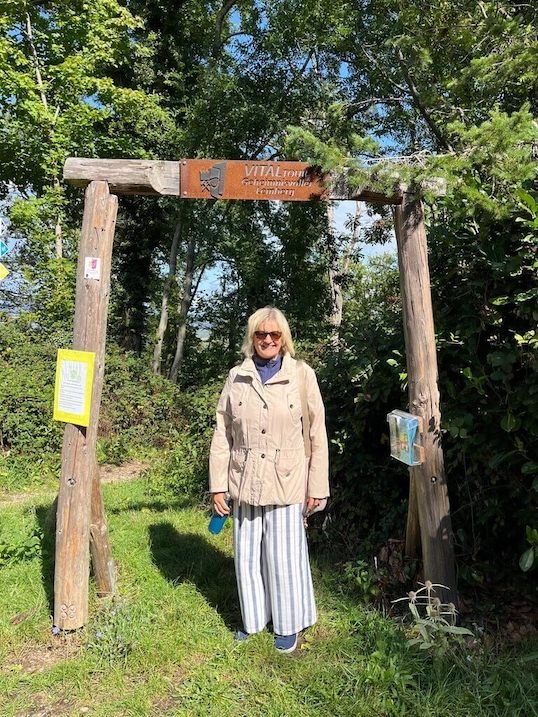
The Lemberg Nahe viewpoint
Enjoying the view over the Nahe Valley from the Lemberg mountain viewpoint: Source - Winekeller
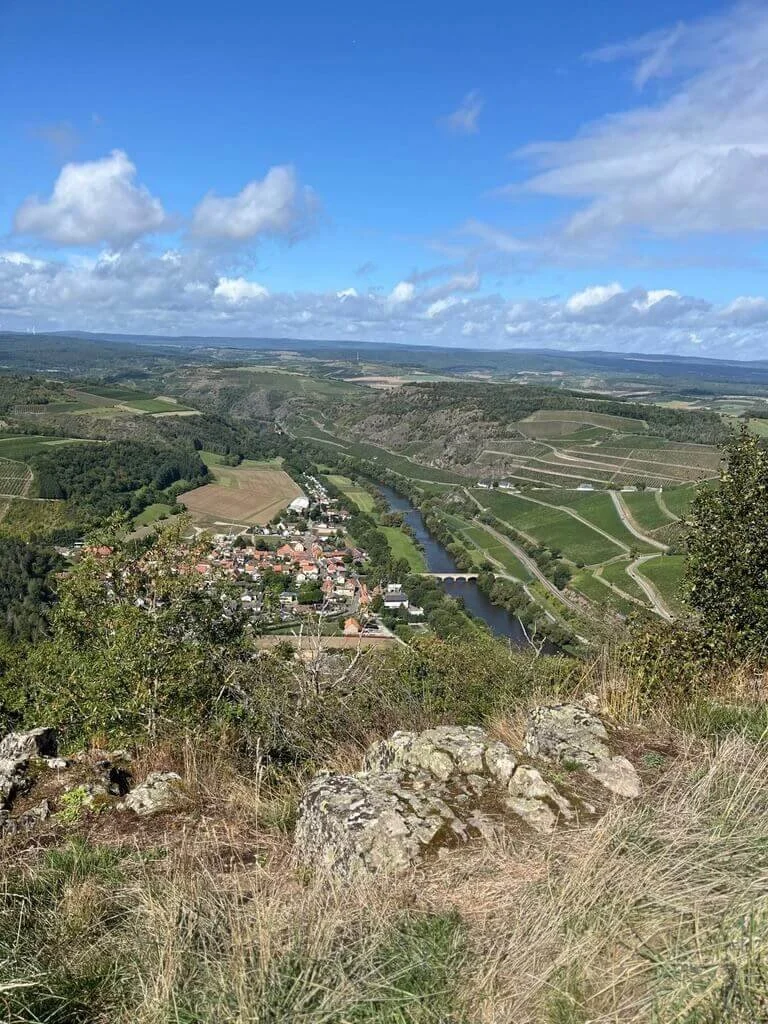
There are some exceptional viewpoints from which to enjoy and appreciate the beautiful Nahe Valley. One of these is from the ‘Lemberg’ mountain, which is the highest elevation in the Nahe Valley at 420metres and offers a spectacular view of the Nahe and the vineyards between the villages of Niederhausen, Feilbingert, and Oberhausen.
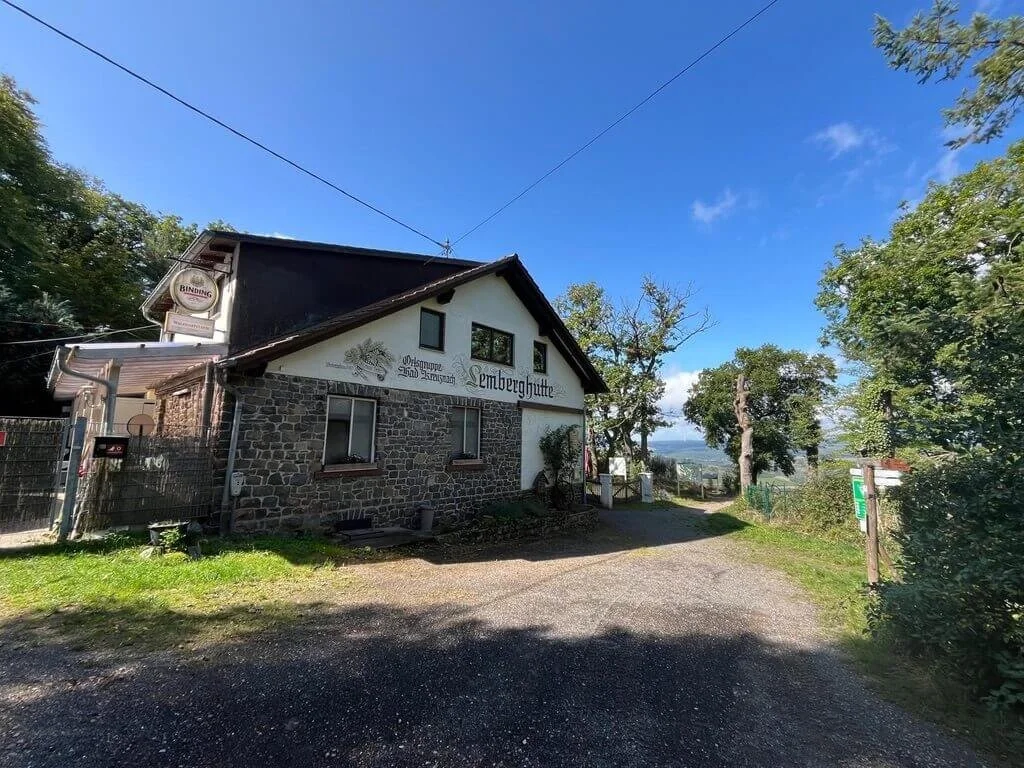
We drove up the Lemberg mountain, through the village of Feilbingert and parked close to the summit and viewpoint. You can follow directions for the ‘Lemberghütte’, a café/restaurant near the viewpoint.
The views are absolutely spectacular, so if the weather is clear, we highly recommend this!
Please note there is also a circular walk around Feilbingert called the ‘Panoramaweg’ which also offers lovely views, but not as striking as from the Lemberg summit.
Cycling the Nahe River Path
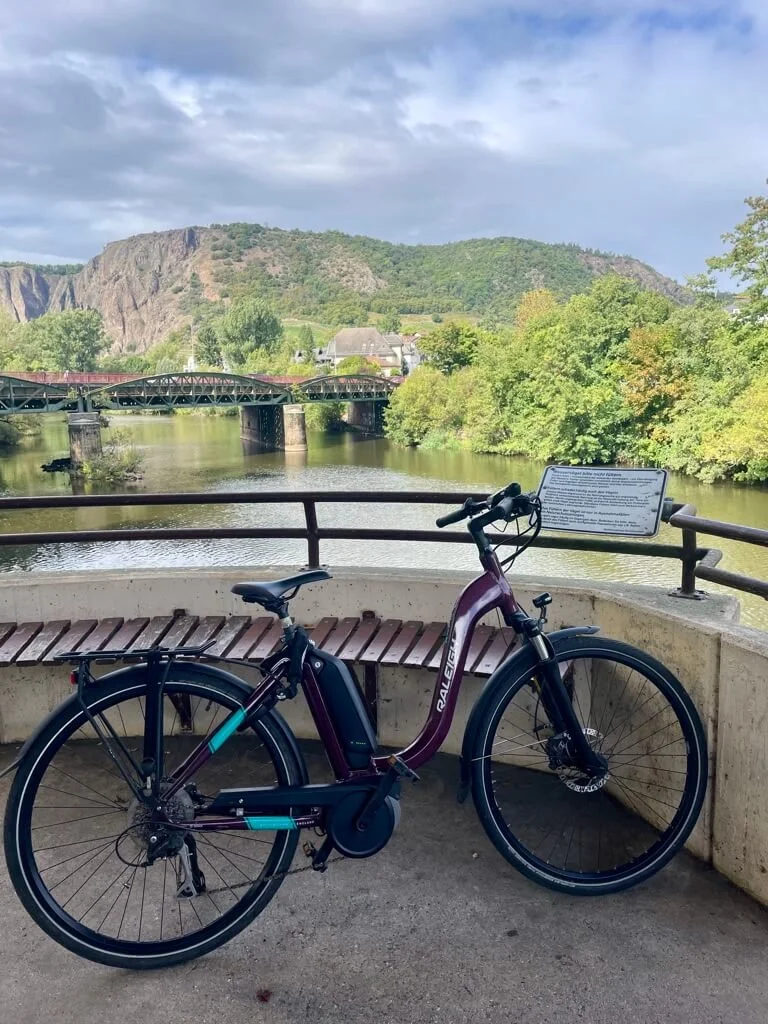
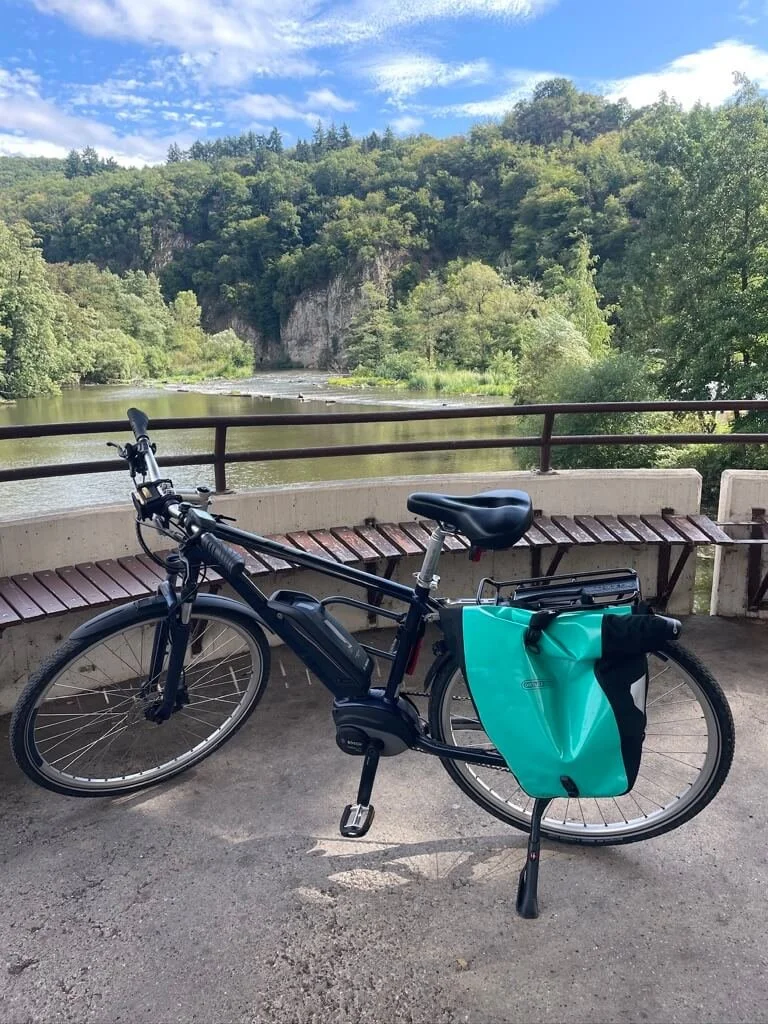
With our bikes on the back of the car we decided to explore more of the Nahe Valley by cycling along the river path from Niederhausen to Bad Kreuznach.
Cycling all 135km of the path from source in the Hünsruck Hills to the River Rhine is categorised as a difficult ride, but the section we did is very easy. The return route was about 24km in total, all off road and next to the river, in part through steep rock formations.
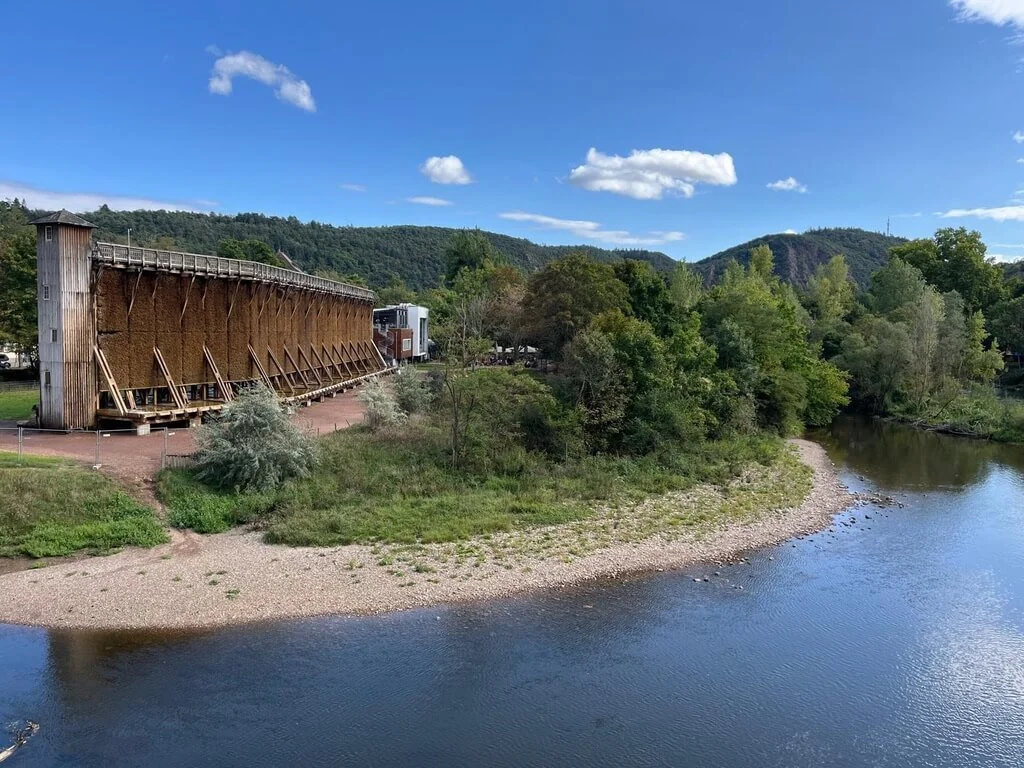
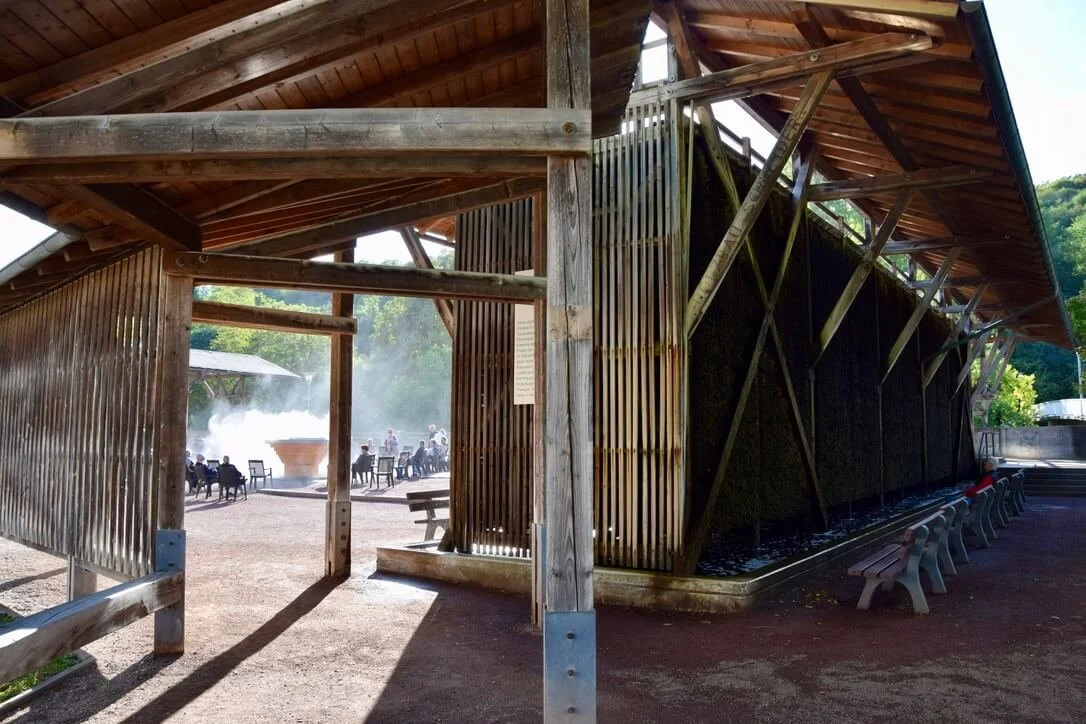
We passed several of the huge ‘salinental’ blackthorn hedges, supplying the entire valley with refreshing, salty air, located in riverside parks where locals and visitors alike can take advantage of them and enjoyed a lovely coffee and cake stop in beautiful Bad Münster am Stein-Ebenburg.
The beautiful views along the Nahe Valley cycle path: Source - Winekeller
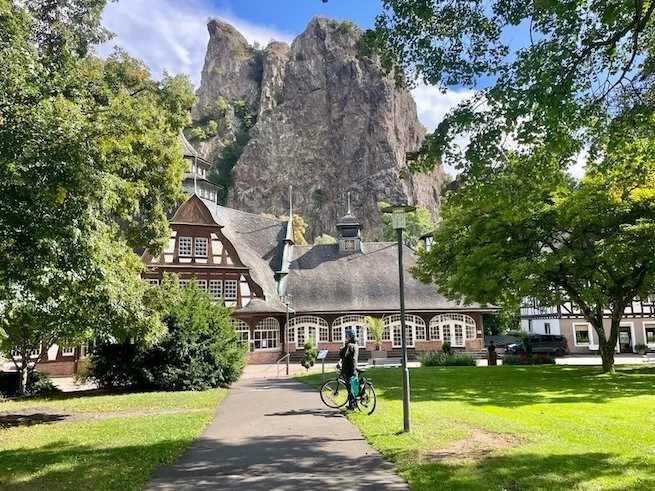
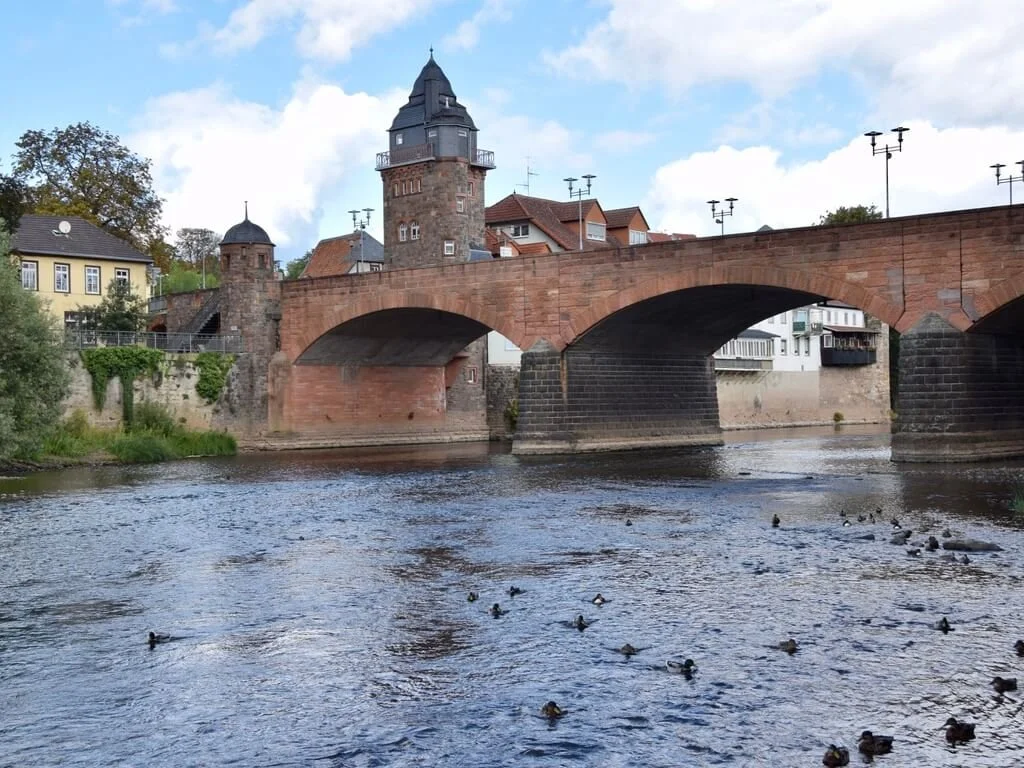
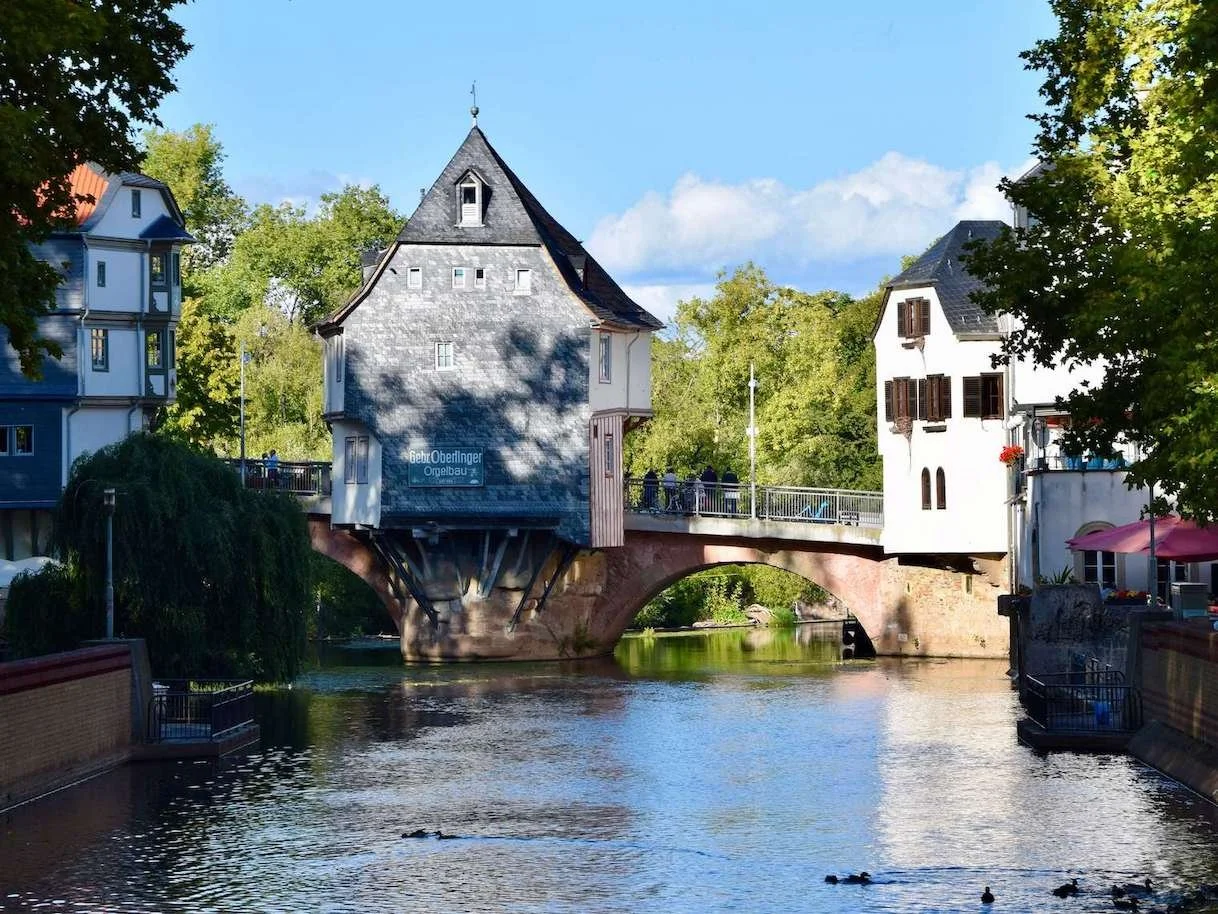
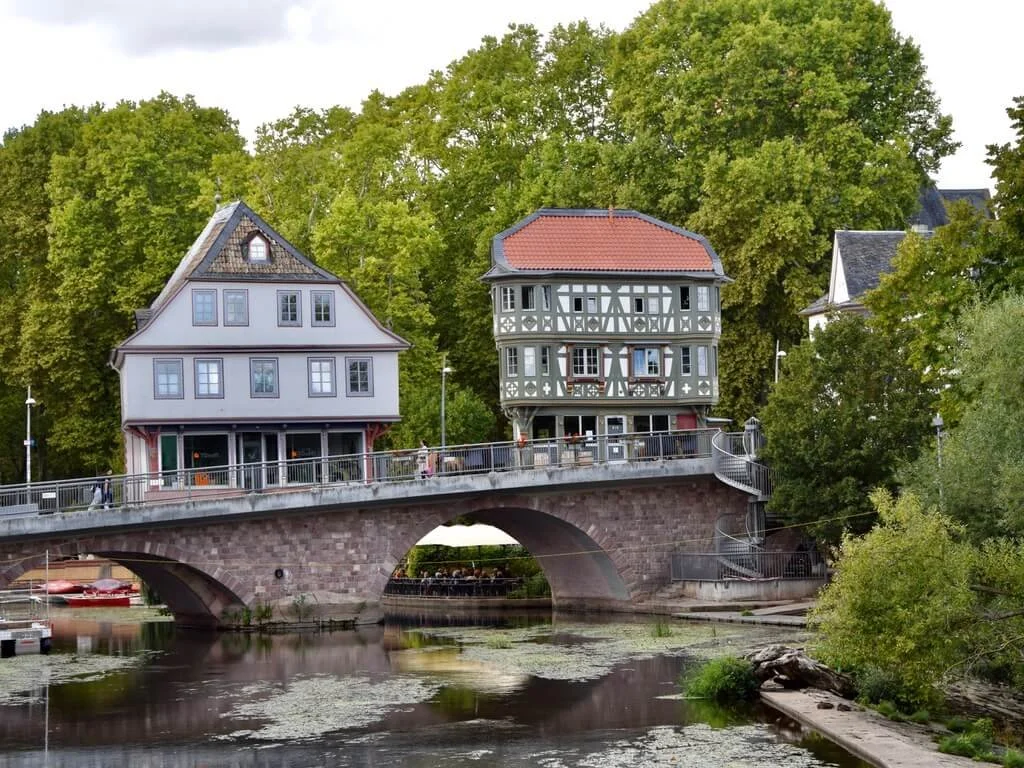
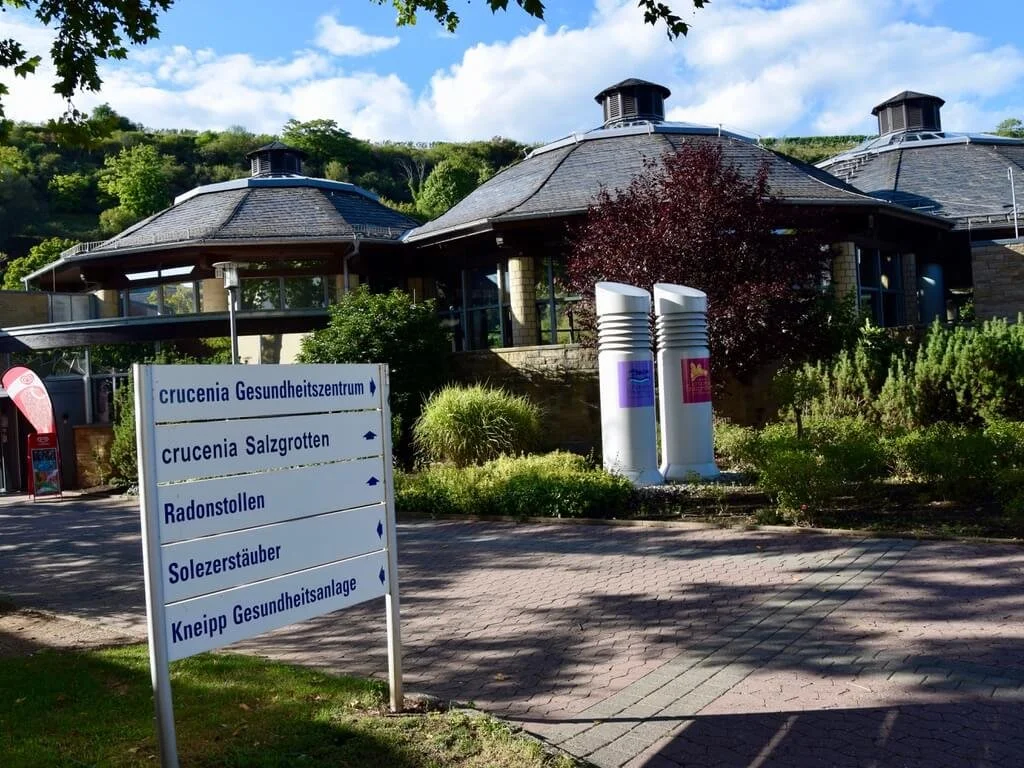
We spent time in the lovely spa town of Bad Kreuznach to admire the medieval Alte Nahebrücke bridge and its famous, timber Brückenhäuser bridge houses and found ourselves returning the following day to spend time in the Crucenia Therma thermal baths. The warm water in the three indoor and outdoor pools here are rich in salt and minerals and is pumped from a spring 500 metres underground - the perfect place to relax and enjoy one of Germany’s most renowned spa facilities.

Conclusion
The Nahe Valley wine region is not as well known outside of Germany as perhaps the Mosel or Rheingau regions, however it’s very accessible to visit and to combine with these other better known regions. The trip is really worth it, for the stunning scenery, the outdoor and wellness activities and of course the incredible Nahe Riesling wines. We loved our few days here and especially loved the wines! Spending time getting to know better the Weingut Dönnhoff wines was very special and of course, we also bought a few bottles with us to enjoy at home!